
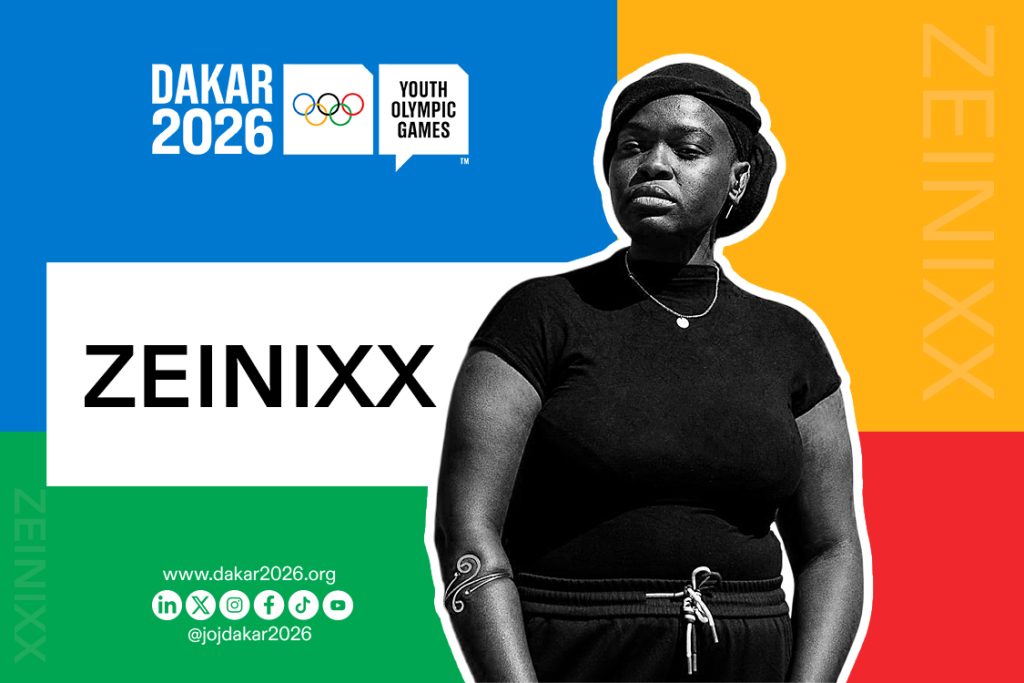
The first woman to break through in Senegal’s graffiti scene, she is inspiring a younger generation to whom she now passes on her craft. A committed feminist, she actively champions women’s place in spaces where they are least expected.
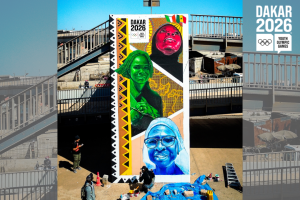
March 2026, in the heart of Colobane. On the façade of the TER station, one of the busiest in the SENTER network, where thousands of commuters pass through each day, an electric scaffold has been raised. Two artists are at work, painting a mural.
Perched more than seven meters above the ground, headphones clamped over her ears, Senegalese graffiti artist Zeinixx is putting the finishing touches on her latest piece. She is painting portraits of three Senegalese sportswomen - Julie Marie Gomis, Combé Seck, and Tening Faye - each a champion in her respective discipline. The work is being created in collaboration with KinMx, an Irish graffiti artist, as part of a partnership between the Dakar 2026 Youth Olympic Games Organizing Committee and the Irish Embassy in Senegal.
A pioneer
Born Dieynaba Sidibé in Thiaroye in the early 1990s, Zeinixx developed a passion for drawing in childhood and turned to graffiti as a teenager. She was searching for a way to express herself freely, without constraint. “I had so much to say. I tried to speak, but I wasn’t being heard. Through graffiti, I found my voice. Walls are vast—they offer space. And I had a lot to say.”
At the time, Zeinixx was among the very first women to take up graffiti in Senegal. Around her, men dominated the scene, and not all welcomed a woman into their ranks. She ignored the criticism. Instead, she put on her headphones, played hip-hop on repeat, and quite literally rose above it, adopting techniques, she says, “so I wouldn’t have to hear them anymore.” In time, her persistence paid off: Zeinixx carved out her place. pour ne plus les entendre ». Sa méthode finit par payer : Zeinixx finit par se faire une place.
Still, she regrets that her path remains an exception in a country where many women lack the same opportunities as men. “Here in Senegal, women don’t have access to many professions. Even today, it’s difficult to pursue certain studies or consider certain careers as a woman. When I started graffiti, I was alone. My parents had other plans for me and asked a lot of questions,” she recalls. “People often asked how a woman could enter this field.”
Passing it on
Though her choice was far from universally accepted among those close to her, Zeinixx nonetheless found her independence and established herself in the graffiti world. She quickly connected with Oumar Diop—better known as Grafixx—who became her mentor.“He really taught me everything. Everything I know, everything I do, is thanks to him. Even my name, Zeinixx, is a blend of his artist name and my own,” she explains. With his support, she began to take her work beyond Senegal, traveling to share her art. In 2018, she participated in a collective mural project in Australia and exhibited her work in international shows.
Now, after decades immersed in urban art, Zeinixx is committed to supporting a new generation of women artists, not only in graffiti, but across disciplines. Music, photography, hip-hop: she is a regular presence at Africulturban in Pikine, a suburb of Dakar, where she works closely with young women.
« J’applique le principe “each one, teach one”. Tout ce que j’ai reçu, j’essaie de le rendre aux plus jeunes. La jeune génération doit s’imposer. Rien n’est facile, mais il ne faut rien lâcher. C’est ce que je leur répète », achève Zeinixx.